

Patrick Dempsey was a guest speaker at the Milken Institute Global Conference.
On Monday (05/05), Patrick Dempsey took part in a panel on caregiving. During the conversation, Patrick presented the work he does with the Dempsey Center and addressed the challenges ahead and put the emphasis on the importance of compassion when it comes to how cancer patients and their caregivers are cared for both during treatment and afterwards.
You can watch the full conversation below.
TRANSCRIPT
Announcer: Please welcome actor, producer and philanthropist Patrick Dempsey in conversation with award winning journalist and executive producer Lisa Ling.
Patrick Dempsey: Alright.
Lisa Ling: Good afternoon, everyone.
PD: Yes, good afternoon. How’s everybody? There we go.
LL: I’m going to try and make an attempt to contain my excitement, because I’m sitting next to Dr. McDreamy.
PD: Oh my goodness. That’s very kind of you. Thank you.
LL: Truly, I’m so thrilled to be sitting here. I know we’re all big Patrick Dempsey fans. And Patrick has a long list of projects and designations. Any Can’t Buy Me Love fans in the room? Loverboy fans? We’re going back. How about Mobsters? Grey’s Anatomy? Yeah, and we know Patrick was designated as Sexiest Man Alive a couple of years ago. Well, I frankly think that the sexiest characteristic of you is your—the fact that you are an advocate, and you are the founder of the Dempsey Center. So if you could, Patrick—first of all, welcome—tell everybody what the Dempsey Center is and what motivated you to found it.
PD: It was inspired by my mom’s cancer journey. She was diagnosed with ovarian cancer in 1998. She would, over the next 17 years, have 12 reoccurrences. So it felt like every two years, we were having to go through it all again. And she really inspired the Center. Now, the Dempsey Center is a place where people are treated not for the disease, but they’re treated holistically. So we don’t treat the disease—we treat the person. So wraparound care. What is that? We work with nutrition. We do a lot of yoga, tai chi, acupuncture, Reiki, massage, counseling—individual and group—and we do support care. And all of these services are at no cost. This is in Maine. We have two physical centers: one in Lewiston-Auburn, where my mother was treated, where—that was the town I grew up in. And now we just opened a new facility, state-of-the-art, in Portland.
LL: It sounds like what you do is human care.
PD: It’s all about the touch. It’s about the psychological and the social aspect of it.
LL: We don’t do that very well in America, human care, do we?
PD: I think there’s a tremendous need for it. There’s a real desire. And once people are exposed to it, then they really embrace it. But I don’t think there’s enough awareness. We do a lot of time and energy spent on developing our drugs, which are really important, but not so much on the holistic side. So what happens is, people come out of their treatment and they’re completely raw. And they’re left to just exist—but they’re not healed. They may be cured of the cancer, but they’re not emotionally healed. And that’s where we step in. And I think it’s really important that we have this discussion. It should be standard care. As soon as someone is diagnosed, the type of work that we do should happen immediately. Because when you go in and you get the diagnosis, it could take you two to three weeks before you actually have a plan on what to do. That’s where we come in. We talk about the nutrition. We talk about the mind and the soul. And we also help the caregivers, which are forgotten as well, and any member of the family. We make sure that they have the support that they need. Because we’ve come a long way, we put a lot of money into the future, but what we’re doing is affecting people right now.
LL: You have said that we do a really good job in this country treating illness, but we don’t treat the human. What do you mean by that?
PD: I think it’s compassion, right? It’s meeting people where they’re at, giving them respect, and understanding what it is that they need. And a patient understands. They need to trust their voice, and we need to support them in that. I think there’s so much volume that’s coming through right now due to the environment, or the foods that we’re eating, the emotion that we’re dealing with. All of this stuff is affecting people and causing these cancers. But we need to talk about the humanity and the compassion in the healing process, and that’s what we’re focusing on.
LL: Because that actually does contribute to the healing process. Once you can be in an environment where you can de-stress and not think about the burden of day-to-day life.
PD: Right, we see what happens when you’re living with a great deal of stress, how it affects your body. It can affect your heart, it can affect so many things. And that energy is going into your cells. And that cell, if it’s weak to begin with, can be susceptible to the cancer. So we have to approach it on all levels. I mean, we need to work hand-in-hand with the oncologists, with the pharmaceutical companies, and do that, and also listen to the patient and go “What do you want to do? What do you feel is right for you?” And follow that. I’ve seen a number of people who do that, and it may not be conventional, but it does work for them. Doesn’t work for everybody, and I think that’s how we have to approach it, it is just compassion and care. The doctors are so busy that it’s very hard to get enough time with them. And the first thing that we have and I think that the thing that’s the most valuable is time with the patient. It’s listening and sitting and going “What’s bothering you? How can we make your life better?” That’s where we begin. Give them agency.
LL: He really is Dr. McDreamy, isn’t he?
PD: You know, I have to say, if it were not for that show, we would not be here today. I would not have been in that position to be able to create the Center. And I think that’s the best thing that’s come out of the show, and the best thing that’s come out of fame, everything else could go away—
LL: Explain why? Patrick, why that show specifically?
PD: Because I think…I think because of the medical world, people were projecting that onto me. So you’re carrying that sort of archetype around, and then you have to work it hard at living up to that. When you have a moniker sort of McDreamy, it’s a very challenging thing to live up to when you’re a human being and you have great flaws. And I think this is really—it gives life meaning. And I think when we are at service, or we’re doing something for the betterment of our fellow man and woman, that’s what life is about. That’s truly fulfilling. And I love it. I absolutely love it. From dealing with our board, and everyone in the board has been impacted one way or another, the survivors that we work with who come in and are volunteers now, it’s very therapeutic for them, the staff, my incredible team, it’s like we’re doing something that’s not about oneself. It’s not about putting more money into your bank account. It’s not about getting more likes on your Instagram. It’s about “How am I making someone’s life better?” And that is what life is about.
LL: You talk about how at the Dempsey Center, you help all of those impacted by cancer, not just the person who is experiencing it or going through it. Who are those impacted by cancer?
PD: It could be your children. We have a great children’s program, so we make sure that they’re heard and they’re listened to. It’s a safe environment for them to talk about what’s happening in their family. Any caregiver, anybody who’s been impacted within that family—we’re there. Or friends, your community. So if one person is diagnosed, you’re maybe reaching five or six or ten, or twenty other people, and we have space for them, and we make sure that they are heard. The support groups are really important. We’re doing a lot now virtually as well. Because we have two centers in Maine, and through COVID—one of the blessings that came out of COVID—is that our Dempsey Connects, which is our virtual Center now, is really reaching a lot of people in northern Maine, especially in the winter, when it’s hard for people to get to the Center, or they don’t have the money to fill up the tank to get down there. We can reach them so they’re not alone, they’re not isolated. So anybody who’s been affected is more than welcome to come, and it doesn’t matter what type of cancer you have, where you’re being treated—all of that is just… just come in.
LL: Let’s get granular for a moment. You say that you provide services for the person dealing with cancer, family members, caregivers—even doctors, you mentioned before.
PD: It’s a program that I think we really want to develop for the nurses and the doctors. I mean, we want our doctors and our nurses to be compassionate, but if they’re dealing with so many people on a daily basis, you can become desensitized. So how do you let them recharge? Where can they come and reflect? And this is a program that we talk about—that you’re starting to see the burnout. And they need to be treated as well.
LL: Give us some examples, for example, of some of the services that children of someone who’s dealing with cancer might have an opportunity to get at the Dempsey Center—or doctors or caregivers.
PD: So with the Children’s Program, the Healing Tree was a program that we developed. And you basically bring children in from all ages, up to about 18, and you sit down, and you’ll find some sort of craft that they want to do—something to just make them feel comfortable in the space. And then the conversation goes: “How are you feeling today? Would you like to talk about that?” And then we have trained oncologists and social workers and therapists who can sort of get to the root of the issue. And that’s what we do, is create a safe environment for them to open up, to be able to talk about what’s happening at home, what’s happening with Grandma, what’s happening with Mom, what’s happening with Dad—all of those things. And that’s the same for the adults as well. The support groups, the peer-to-peer, is very important. And what’s really beautiful is the survivorship. Now we’re seeing more people, if we get in, we get our testing, we get our screenings done, and we’ll get diagnosed, we can get treated, we can go out and have a productive life. But then you’re still dealing with what’s happening after that. What, you know, “Is it going to come back?” So the survivors coming in, and then connect. them with a newly diagnosed person is magical. It’s so good for both people, and this was really important for my mother, so that’s another opportunity for us as well. We do that.
LL: Talk about some of the transformations that you have witnessed at the Dempsey Center. I mean, you know, when people get diagnosed with cancer—and let’s face it, it could be any of us, given the rise of cancers in our culture, in this country—tell us about how, after receiving services at the Dempsey Center, they go through such a life-changing transformation that is actually even potentially healing for them.
PD: Yes, it is. And I think what’s great is when you’re spending time in the Center and you’re talking to people, and you’re greeting people, you see that transformation. I think there’s a tremendous resistance coming in, because it’s a fear that’s based in… And this came from a conversation with a woman came in. She was looking around, and I was like, I happen to be there that day, and I’m like, “Can I help you? Can I show you around?” She goes, “No, no, no, it’s not for me. I’m just checking this out for my husband.” Her husband would not come over. Would not come over. He was scared to death, because even though he was getting his infusions and he was doing all that, it admitted to himself that he had a problem, that he had cancer if he came over to the center. So once we got him there, he transformed, and through the acupuncture, it took away his pain in specific areas, and he could see it. It was immediate. And then he opened up, and then he just started to smile, and the energy in the room changed dramatically. And you see that time and time again. In the Reiki, that human touch, they’re becoming aware of their bodies for the first time. “Where is the pain? How are they feeling?” And you see them coming out after the session, and they’re just, it’s like a weight had been lifted, a light has been reignited in them, and their flame is lit, and they’re alive, and they’re experiencing it. Or what happens is someone will take this and do something with it. We have a wonderful man who created Man Up To Cancer. There was no support for the men in the community. And this is ridiculous. We need to be able to communicate, but we need to do it in our own way. And he used his time at the Center, and we encouraged him to continue on doing something, and he’s done a great job. So they’ve turned it around and made something positive out of it.
LL: You talk about these holistic therapies that you provide. I have a friend who is dealing with stage four bladder cancer, and he is in excruciating pain every day. And he says that the one thing that gives him a little bit of relief, that he has been looking forward to a couple of times a week, is Reiki therapy. It just calms him down a little bit. But now he can no longer afford to have the Reiki therapy because it’s not covered by insurance. You all provide this for free. But why should we care that people like my friend Marco can get Reiki therapy? Why should the people in this room care about people receiving those kinds of holistic therapies that our insurance doesn’t cover?
PD: Right? It’s a shame that the insurance doesn’t cover it, because it will save them money in the long run. It will keep them from going back into the hospital, right? So this is why we should care. It’s helping them. And these are just—these are things that have been around a really long time. They’re proven. And that’s part of our job too, it’s to write a paper to be able to prove, “Okay, look, we’ve made an impact. We’re improving people’s lives. The quality of life is improving.” That’s why we should care. And he’s taking a moment to get in touch with his body, and he’s feeling better, and we’re healing them. And it’s like—you have to look outside the box. And these services—people should be aware of them, number one—and they should be free, or they should be covered by insurance. This is our goal. This is why we’re here at events like this— it is to talk about it and to bring more awareness to it. Acupuncture takes away a lot of pain. It’s a wonderful thing. People are skeptical at the beginning, and they come out like “Oh my god, this is amazing.” This woman’s shaking her head over here in the audience, so she knows. And I have a question—do we have any cancer survivors in the room today? There we go. [To the audience member] Now, are you okay talking about this? Did you get any wraparound care when you were going through your treatment. Here, I’ll bring the mic to you. Don’t get up. I love this. I’ve always wanted to have a talkshow. So tell us your name. I know. I know I saw it. Go ahead.
Audience Member: Okay, I had endometrial cancer. I had a hysterectomy within a month of my diagnosis. I had been going to acupuncture for 32 years, so, like, I already knew what I was doing. I was always involved in holistic medicine and holistic care. And if I didn’t have that as my go to I wouldn’t have known what to do. Like, it saved me, I and it’s just who I am, you know, it’s part of me and everything that I do. So what you’re doing in the Dempsey Center, what we’re doing today is why I helped create this panel.
PD: Lisa asked the question, why should we care about those type of services?
LL: Patrick talk in the mic.
PD: Oh sorry.
LL: Talk in the mic.
PD: So I’m just asking the question once again. It’s like, “Why should we care?” And I’ll let you answer that because you’ve had the experience.
Audience Member: Because I feel that you’re treating the whole person, not just the disease, right? And that’s what I knew I needed to do for myself when I went through my journey. And I know that friends of mine who’ve been through chemotherapy that they go—when I tell them they have to go to acupuncture, they have to go get Reiki. Then I have Reiki Masters, like, sending them Reiki from afar. I’ve done all kinds of things for the people in my life who’ve been sick. It’s just an absolute necessity, you feel better, right? And it’s not just about Western medicine. It’s about Eastern medicine, it’s about holistic medicine, and everything that you can do to feel better and feel good about yourself. Like, that’s it.
PD: There you go. [AM: Thank you.] That’s the answer. [LL: Thank you.] And that’s why, right? So you have to get out of the clinical environment, and you have to have warmth and compassion. And in our society right now, we’re so scared—it’s so hard to be vulnerable. If you’re vulnerable, you’re going to get attacked. And I think especially for men right now, it’s like—your strength, gentlemen, is in your vulnerability, right? It’s not in this sort of bravado that we’re all being taught. It’s how can you show your empathy and your compassion? And I think this is why the Center is so important, right? You’re cared about. You’re not just a number, and we gotta get you in, get you serviced, and get you out. It’s like “How much time do you need? We’re here for you as long as you need us”.
LL: Well. And Patrick, talk about the numbers. I mean, as I said earlier, the rates of cancer diagnoses is exploding in this country.
PD: Oh, it’s staggering. And more and more younger people too, because we’re not exercising. This is the other thing that we talk about. We have the Dempsey Challenge, which is our major fundraising event. I don’t particularly like banquets, although we’re going to one tonight—but I think it’s—you want to get people active. And it’s like, let’s get together so you get out on a bike, right? I love cycling. That’s my form of release and meditation. My mom liked walking, so we do a walk, and we do a run. People love running. And this is to really get people active, right? If we can stay active and get out, you’re going to be better. It’s proven. I mean, all the data is there. That’s going to help you right away. And that’s one of the things that we encourage. And you’re seeing more and more younger people that are not active, and that’s why these numbers are just skyrocketing. The industrial food complex—what we’re putting into our bodies—is horrendous. Look at the obesity rate that’s then leading to other forms of cancer. This is all preventable.
LL: The Dempsey Center is a brick-and-mortar facility in Maine, but you have programs—35 programs—throughout the country.
PD: Well, we have, we reach 32 states and four countries. A lot of people come through in the summertime, and then they register with us, and then we can reach them when they go back to their winter homes. Unfortunately, because of the legislation right now, we can’t do all of our counseling. We have some states in New England that we can work with, but we would love to be able to reach more people nationally and internationally.
LL: So in what way can the Dempsey Center become a blueprint for the rest of the country in terms of the services that are provided—virtually or in-person?
PD: Well, it’s the model, right? We just want to show the model. So I think that’s our goal. I think it would be virtually impossible for us to have brick-and-mortar everywhere. The reason we’re successful is because of our community. We get a lot of individual funding—just everyday people working very hard at raising money. It’s very competitive, and we wouldn’t be able to exist without them. We have great support with local businesses because we do a lot of outreach and say, look, I know this was important for my mom. She wanted to go to work. People want to get up and be productive. They need to have a reason to get up in the morning and not just sit in their room and wait to the next treatment. They need to go to work. And local businesses understand that. And we spend a lot of time reaching out to them, saying “If you have anyone in your office or your business that needs help, please let them know”. And also get a team involved. Be active, be together as a company, and participate in the Challenge. And it’s a great way to build the team spirit and a great sense of culture within the community. So that’s it. But we would love to be able to go to other states or other communities that want to start this up and help them set it up.
LL: Well, how—how are you all funded? And in what ways could the Dempsey center proliferate?
PD: Well, it’s individual donors, some corporate. We have some relationships with some pharmaceutical companies. Amgen was really important for us at the very beginning. I got involved with them, with their initiative called Breakaway from Cancer, and it was four or five different disciplines, and that’s really where I, for the first time, was aware of wraparound care. And I was like, this is what we need in our community at home. And I wanted to do something in my own backyard. I remember, before I left Maine, they were saying, “Never forget where you came from. Don’t forget where you come from.” And I wanted to do something in our community. And that was a way of giving back. And it was through my relationship with Amgen and that initiative that really began that. So we have some corporate responsibility sponsorship there. Pfizer has been very helpful. They’re very, you know, forward-thinking in their oncology work. That helps partially, but a lot of it is individual donors, and that’s the remarkable thing, it is the community keeps us going and keeps the door open, and we’re grateful for that. And that’s a lot of responsibility for us. We want to make sure that we can keep our doors open and continue to provide services at no cost. But now, with the potential loss of Medicare and Medicaid, the demand for the services is going to be that much greater. And we’re going into a very challenging time financially, so raising that money is going to be much harder for us. We want to make sure that when someone comes in, they can get to our services within—what is it?—one or two weeks now? We want to make sure that it doesn’t go to three or four or five weeks. We get into that pattern when we don’t have enough money, because we don’t have enough staff that’s qualified to do what they need to do.
LL: And it occurs to me—I asked the question, why should we care that my friend Marco is able to get Reiki treatment? And the truth of the matter is, it’s because Marco could be your friend. Or Marco could be your mom, or your dad, or your sister. Or Marco could be you. And so that’s the reason why it’s so essential that we get access to these holistic kinds of services. We’ve about run out of time. But I’d be remiss if I didn’t ask you about caregiving, because as our population ages and as cancer diagnoses rise, how can we become more of a caregiving conscious culture?
PD: I think first by caring, right? That’s the key. It’s like—you, you’re, we’ve—you know, at the very beginning, everybody was like, “Go west, young man, and go, go, go”. There’s nowhere else where we can go. Now we have to rely on our community. We see this, certainly in the Palisades, a complete community wiped out due to the fire. We’ve lost our sense of community, a sense of belonging, of caring about your neighbor. And those are the things, it’s compassion, is a healing property that is powerful, and we’ve forgotten that. We’ve forgotten it, even in this big city. You know, if you take the time to go, “Are you okay? What’s going on with you?” and you understand where they’re coming from, it’s much easier for you to be compassionate. And I think this is important for the caregivers too. They’re holding so much responsibility. They’re having to be strong for the cancer patient—but who’s listening to them? Where do they go? So there needs to be a place for them.
LL: Patrick Dempsey.
PD: Lisa, thank you.
LL: Thank you for caring. Sexiest man alive on the outside, but I think you’ll all agree, sexiest man in here, too. Thank you so much.
PD: Thank you. Thank you everybody. Thanks for your time.
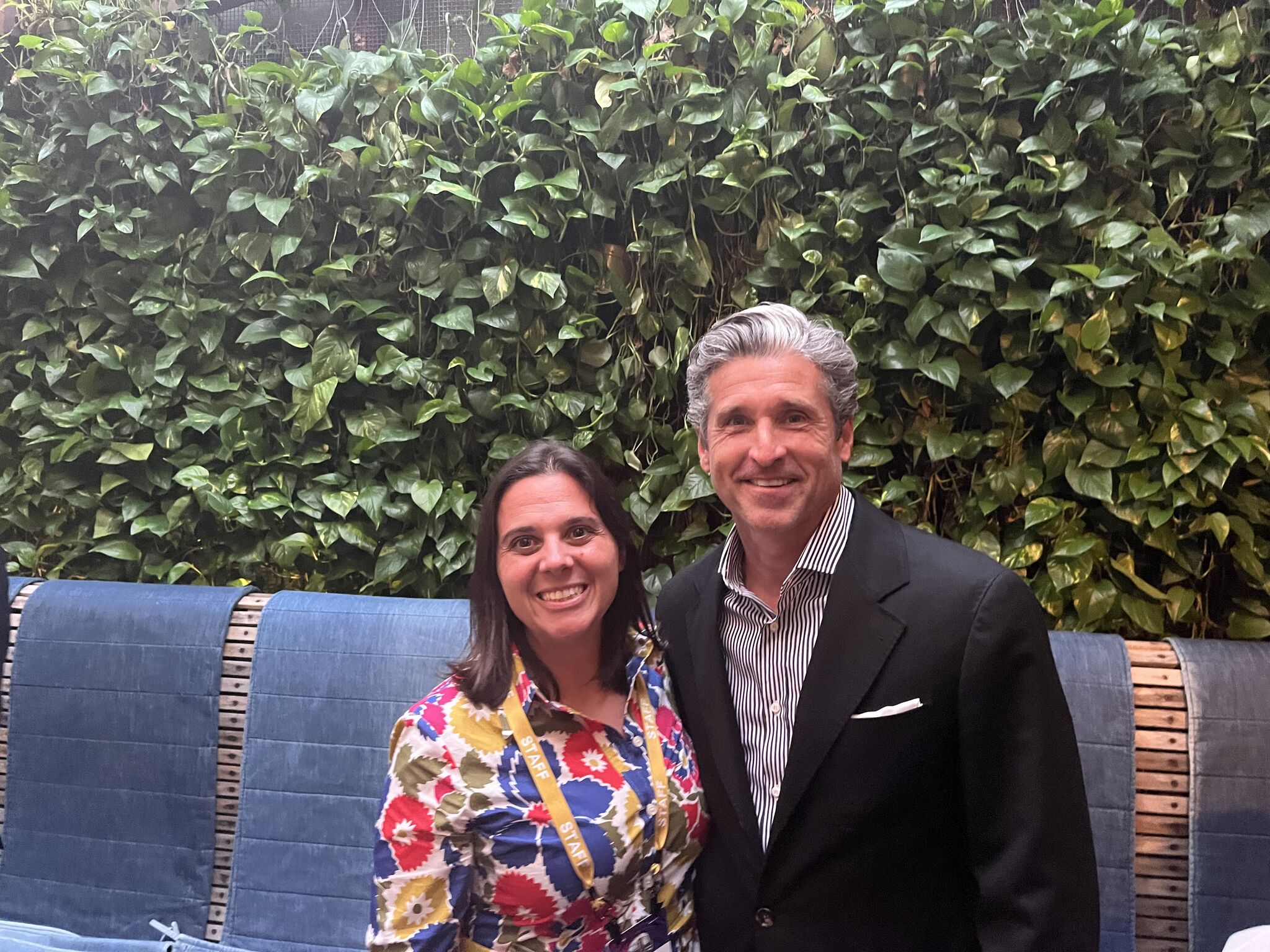
He also took the time to take photos with other attendees. All photos are available in the gallery.
Discover more from The Dempsey Hub
Subscribe to get the latest posts sent to your email.
 The Dempsey Hub