
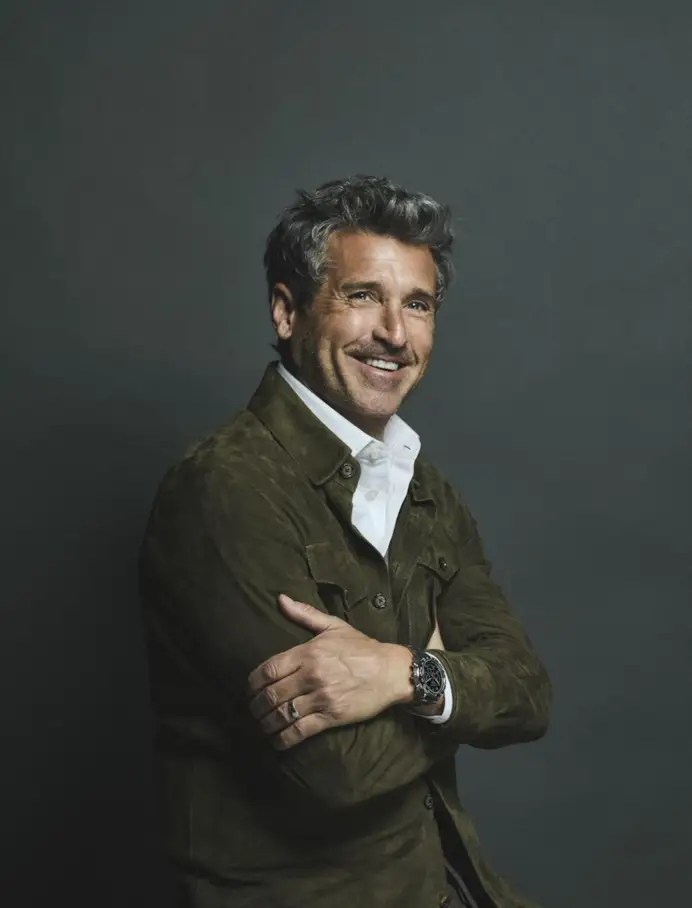
In a new interview Patrick Dempsey discusses racing, his relationship with TAG Heuer and shares a few words of wisdom on life.
Patrick Dempsey: “The real luxury? Having time and being able to choose”
From endurance races to the passion for watches, the American actor shares what it really means to win, why time is the rarest luxury and how to learn to fully live every moment.
“You grow by trying, making mistakes and continuing to improve. True luxury comes from experience and, consequently, from time. We must learn not to waste it, to live fully in the moment”. Patrick Dempsey starts from time, but talks about life. He does it with the awareness of those who have learned that every goal is only a stage and that success is not measured in results, but in the ability to stay true to themselves. Actor, driver, entrepreneur (he is the owner of Dempsey Proton Racing and active in several tech, food, health companies), he has also been a TAG Heuer ambassador since 2014. A role that seems to be tailor-made for a watch collector and a man who has made a philosophy of life over time.
Gentleman: More than ten years have passed since your relationship with TAG Heuer began. In a world where everything seems to move so fast, what makes a partnership truly authentic and lasting?
Patrick Dempsey: The answer is precisely authenticity. It is a collaboration born in the right way, built over time and conquered with commitment. That’s why it always seemed sincere, consistent both with the brand and with me. I think that’s exactly why it’s been going on for so long. It is a relationship that appears natural, spontaneous, fluid and authentic. I also think it relies on my passion for motorsport. Technology, innovation… are all aspects that meet naturally. This is why it is very easy to talk about it and play the role of ambassador, talking about the watches and the experiences that accompany them.
G: If this journey with TAG Heuer was measured not by time but by the moments lived, which memory would best represent this journey? From the paddock to Le Mans to the streets of Monaco, what makes it truly unforgettable?
P.D: The fact that it lasted so long. In recent years there have been so many exciting, deep and really special experiences, which lead you to appreciate every single moment. And it is also the way we should live life: to be present. In this sense, the symbolism of the watch and time is precisely about this: to fully live the instant and get the most out of it. Be present.
G: Steve McQueen remains one of the greatest icons of male style, famous for a classic but absolutely personal elegance. Like him, he was an actor and a great car enthusiast, as well as being one of TAG Heuer’s most representative faces. Do you see any similarities between his way of understanding style and yours?
P.D: Steve McQueen was authentic regarding what he was and what he believed in. He wasn’t particularly worried about appearances, although he was very aware of his own image and how to build it. It is curious, however, because today it is remembered above all for the film Le Mans, which when it came out was a complete failure. Even the Monaco, when it was launched for the first time, was not successful. Only many years later was he recognised as an extraordinary icon. This teaches us an important thing: sometimes your generation or the moment you are experiencing is not immediately understood. It takes time for their value to be recognised. This is why it is essential to focus on the process, on doing, on being present. Once again, everything revolves around presence. You never know what will happen in the future or how what you are doing will eventually leave a mark. I think Steve McQueen has influenced a lot of people precisely because he has remained true to himself. He didn’t try to imitate anyone. Today, however, it is the others who look at him as a reference point for style, for masculinity and for an image that has now become iconic.
G: He is one of the few Hollywood actors to have really competed in high-level motorsport. How much do the preparation for an endurance race and the one to play a role have in common?
P.S: Preparation for endurance races, such as the 24 Hours of Daytona, Le Mans or similar competitions, requires a total level of dedication and commitment. You have to be willing to make sacrifices to be successful. Then comes the moment when you really test yourself and your limits, especially from a psychological point of view. You have to understand how far you can go, overcome that barrier and learn to feel comfortable even in discomfort. And that’s where the best results often come. This experience can also be transferred to teamwork, when making a movie or a television series. At a certain point you perceive that everyone is working in the same direction. You understand that chemistry is the right one, that the culture of the group is the right one, that the mentality is the right one and that this is the place where you can give your best interpretation.
G: Racing is a passion that has been with you all your life. What did the wheel of a racing car teach you, on a personal level?
P.S: It’s an experience that makes you very humble, because there’s always someone faster than you and there’s always room for improvement. This is one of the most beautiful aspects. After a weekend of competition you come out regenerated. You went through many moments of difficulty and you learned to manage them. In the end you feel great satisfaction if you gave your best, or frustration if you made a mistake and failed to express your full potential. For me it is an extraordinary metaphor of life: trying to continuously improve, becoming more efficient, not wasting time and understanding where you can get small improvements with minimal effort. All these things make the day more fulfilling. I really believe that they are wonderful metaphors of life.
G: TAG Heuer has built much of its identity on accuracy and time measurement. What is your relationship with time today? Are you trying to control it or have you learned to accept the unexpected?
P.D: I remember when I participated in the Baja 1000. The team principal kept telling us: “Get ready to expect the unexpected”. At first I thought: “But what does it mean?” Then, during the race, a flat tire happened, a mechanical problem or any other unforeseen event… and you simply adapted. It is an approach very close to Buddhism or stoicism: the real question is how to control one’s reaction to what is happening, turning that situation into something positive. You can’t deny reality. You have to accept it and move on. I think this is, after all, the answer to the question. That’s what we need to focus on. It’s a very simple concept, but incredibly difficult to remember. And it is one of those values that we should teach our children and ourselves every day. If we did, we would all be much better off.
G: Speaking of values: if you had to describe yourself with three words that also reflect TAG Heuer’s values, which ones would you choose?
P.S: It’s a curious question, because the slogan is Designed to Win. So the real question is: how do you plan yourself to win? How do you build your life to win? And most importantly… what does it really mean to win? For me, winning means being perfectly aligned with who you are and living authentically. When you look in the mirror, when you look inside yourself, you must know that you are living your truth. And it is one of the most difficult things to do, especially today, when we are constantly bombarded by the media, Instagram and social media, which make us believe that we have to be in a certain way. In reality, you have to learn to look inside yourself and listen to yourself. It’s very difficult, with all the distractions around us. And it’s also the reason why I always go back to the races: because they free the mind and force you to live in the present moment.
G: When you look at a watch, what catches your attention first: the design, the mechanics or the story it tells?
P.D: The story. Without any doubt.
G: If you had to choose three watches from your collection that represent three different chapters of your life, what would they be? And why?
P.S: This is really a very difficult question. It’s like asking who your favourite child is. I would say the first watch I had in Le Mans. Then that of the fusion period. Subsequently, the one born from the collaboration with Porsche. And… maybe I would also choose one of the classic models, because it reminds me of Jack Heuer and the whole legacy of the brand. Or the current Monaco, which represents where we have arrived today. I would say that those three watches represent the beginning, the central phase and the present of my journey.
G: Many enthusiasts buy a watch to celebrate an important moment. Is there a timepiece in particular that represents a victory, a risk taken or a turning point in your life?
P.D: Yes. I have a lot. Each of them harbours exactly that kind of memories.
G: With your racing team you have also experienced motorsport from an entrepreneurial and managerial point of view. What qualities do a great team principal, a great actor and a great luxury brand have in common?
P.S: You’re always worried about being able to pay the bills! Especially when you live on sponsorships, you are constantly committed to keeping the team competitive and financially sound. You need to make sure you have the budget to keep working. The same goes for cinema: making a film requires the right elements to convince someone to finance it, and it’s anything but simple. I go from looking for funding for a film to looking for it for the racing team, and in both cases it’s an ongoing challenge. I believe that every team principal lives like this: trying to make sure that the sponsors are satisfied, that there are enough resources to support the drivers, the team and the whole team. In short, you learn to live with a good dose of anxiety.
G: Racing cars and technology continue to evolve at an incredible speed. What remains timeless and indispensable, despite all this innovation?
P.S: I think it’s essential to never lose your DNA and remember where you came from. I think this is one of the reasons for TAG Heuer’s success. When you see the brand, you immediately know what it represents. If you are a watch enthusiast, you know exactly what to expect. It’s a bit like the Porsche 911. Its shape has not changed radically over time, but has evolved. The same goes for the Monaco: if you compare the first models with the current ones, you notice that today they are slightly larger, much lighter and built with better materials. It is an evolution very similar to that of racing cars: they are lighter, more reliable, more durable. They are continuous improvements. Not big revolutions, but many small steps forward that allow you to evolve without losing your identity. And I think this is fundamental.
G: You embody a modern idea of masculine elegance, which seems to be based more on substance than on appearance. How has your idea of luxury evolved in the last ten years?
P.S: For me, luxury is feeling comfortable. It’s what makes you feel good, what gives you confidence. Luxury can take many forms. It can be simply having space around oneself, or being immersed in nature and being able to appreciate it. This is also luxury. True luxury lies in the quality of the experience and the quality of the realisation of an object. When something is handmade you feel it. When an object has a special quality, you feel it immediately. You understand that there has been time behind it, and the play on words is inevitable, experimentation, trial and error. Think, for example, of the new Solagraph movement: it took years of development and a long process of improvement. And, once again, I think that’s exactly what life is. Try, make mistakes, improve and continue to improve.
G: What is the rarest luxury today: having time, having freedom or being able to follow one’s passions?
P.S: I’d say it’s the mix of all these things. Having the time and freedom to cultivate your passions. And, above all, be present while doing it. There is also another aspect: the luxury of being able to choose. Having the opportunity to decide what to do, what to wear, who to be. To be able to choose with awareness, without being forced to constantly chase something or to always be in a hurry. Being able to be with yourself. It’s one of the reasons why I love going home to Maine. There I can stop, to reflect on how far I have come, on where I still have to go and to appreciate the point where I am today. For me, true luxury is precisely this: being able to enjoy what you have, without being continuously dominated by the desire to have something else.
G: Looking at the different chapters of your life, actor, director, entrepreneur, husband and father, what role has taught you the most about what really matters?
P.D. The children. Raising children is the most difficult thing in the world. It is also the most rewarding, but undoubtedly the most challenging. And it leads you to look at your parents with completely different eyes. You really start to appreciate everything they have done for you, the difficulties they have overcome and the sacrifices they have faced. Then, when you become a parent, you find yourself doing exactly the same thing for your children. And you hope that one day they will be able to understand it. I think this is important to remember: as children they can’t understand it and still can’t appreciate it. Sometimes I think about my mother, my father and then my children. I wonder when that moment of awareness will come for them too. And I smile to myself, because I know that one day they will laugh too.
Discover more from The Dempsey Hub
Subscribe to get the latest posts sent to your email.

